Kate De Goldi's kōrero from our Programme Launch
14 August 2026
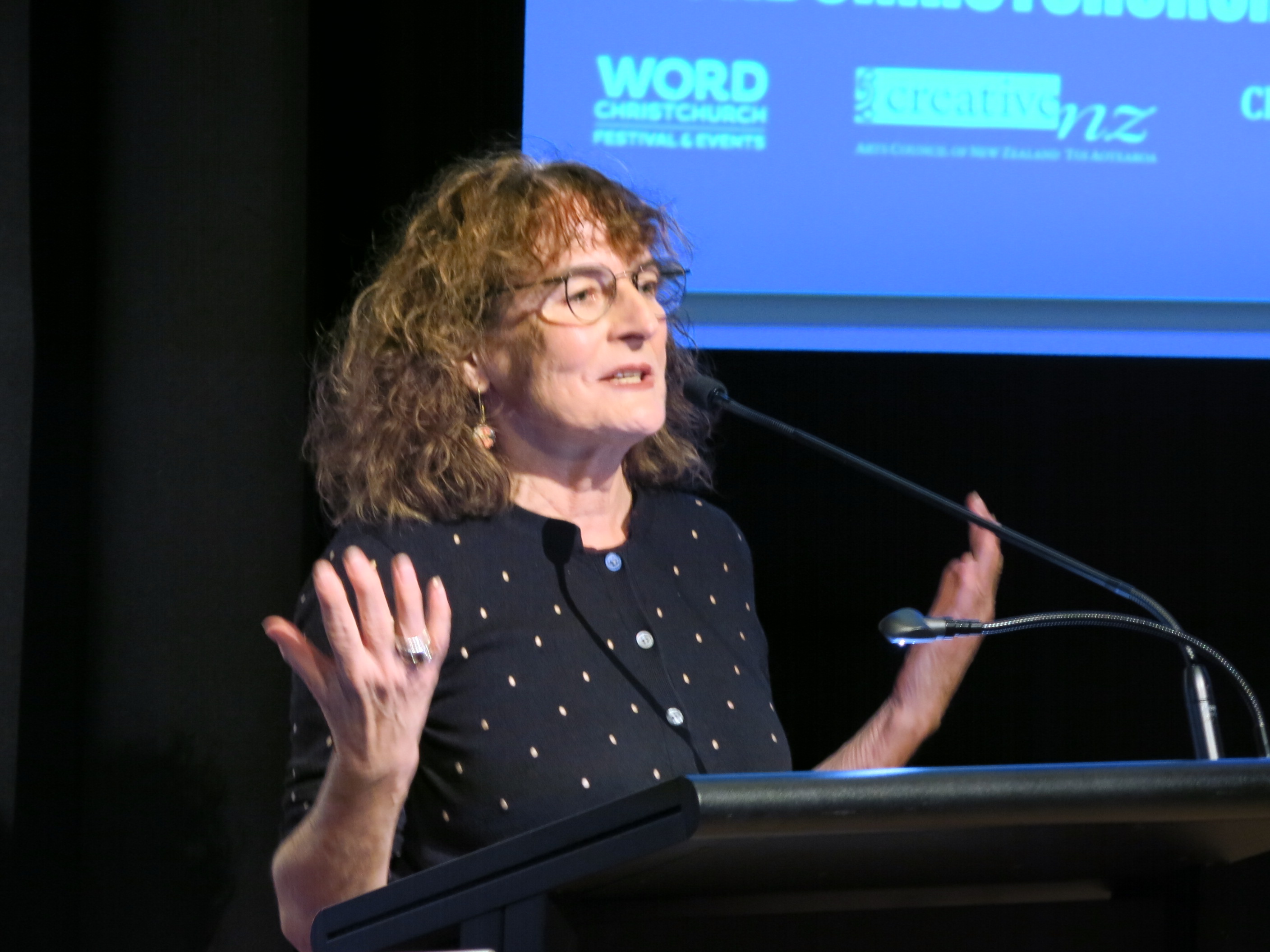
Due to popular demand we're publishing Te Awhi Rito Reading Ambassador Kate De Goldi's impassioned plea for us all to read, which she shared at our WORD Christchurch Festival Programme Launch on Wednesday 15 July 2026.
Kia ora tatou katoa,
Hearty congratulations to Kiran for her consistently imaginative and far-reaching programmes. Roll on September! Congratulations to Steph, festival trustees, staff, and all of you who help sail the good ship WORD by funding, sponsorship, and not least, voluntary work.
Thank you Kiran for the opportunity to speak briefly as Te Awhi Rito Reading Ambassador – about what is effectively a mission to rebuild a nation of readers. I’m charged – as were the two Te Awhi Rito before me – with advocating for, modelling, and inspiring reading in the children, whānau, families and communities of Aotearoa. In other words, everyone! No mean task – and of course no one person does this alone. The role is a cumulative and iterative one, each succeeding Te Awhi Rito addressing different aspects of the enormously complex jigsaw puzzle of our reading crisis. The role was established six years ago by the National Library in response to a large body of research evidence, both here and internationally, that consistently pointed to: sharply declining reading for pleasure amongst children; a vertiginous decline amongst teenagers (more than 50 percent of New Zealand teens don’t see the need for reading) and an increasing decline across all other age groups and sectors, including, worryingly, educators. The research also strongly indicated that a public reading role model was a necessary part of a multi-faceted, long-term effort to rebuild reading for pleasure in Aotearoa.
There are multiple reasons for our reading decline, a complex interplay of factors, including increasing economic disparity, the growing burden of work across all communities; inequities in access to reading matter, the heavy socio-economic demands of parenting and family, a sharp increase in mental health problems, over-burdened educators … and so much more … Then there’s the formidable array of competing leisure alternatives – long form television, film, youtubing, gaming, to name just some; and the advent of the smart phone and its enticements, resulting in the colonisation of sentient humanity! What must be said is that there is a clear correlation between the appearance of the smart phone–social media–24 hour news cycles, and reading for pleasure heading sharply south.
What are the consequences of the decline in reading for pleasure? What does it mean for individuals and communities, and indeed, a nation?
Lifelong readers – many of you in this room – and those in the literacy and library worlds have always been happily confident of reading’s enchantments and transformations, and the fertile ground of thriving reading communities. Unfortunately, earnest epistles on reading’s broad benefits have, until quite recently, proved unconvincing – unscientific – to those who believe reading for pleasure is little more than a passive recreational activity.
But we now have available a vast amount of – both nerve-wracking and galvanising – data which should concentrate the minds of decision-makers in education, local and central government, and multiple other sectors across the country:
The data makes powerfully plain that reading for pleasure is fundamental to young people’s development of full critical and digital literacy and fundamental to educational success. Ipso facto, it is foundational to social and economic achievement. Further, and significantly – given our beset contemporary world – we know that reading for pleasure builds empathy and contributes to sustained well-being across a lifetime. It also – crucially – builds the capacity for critical thinking – an essential skill for navigating a world now awash in misinformation and disinformation. Furthermore – and I find this so potent – a dedicated reading for pleasure habit, the research says, is a more powerful determinent of a student’s success in life than their parents’ income.
This is the message I’m seeding with community groups, parent communities, schools – whose reading habits culture have greatly diminished over the last 20 years – and decision makers in different sectors across Aotearoa.
Some other pungent research findings:
Screen life has diminished attention spans across the board – but disastrously for young people in terms of their educational outcomes. We’re flooded by tsunamis of information on platforms that encourage skimming, browsing, word spotting, and infinite distraction. Moreover, we’re increasingly attracted to the outlets that offer the swiftest, most simplistic, most digestible distillations of information. The advance of AI will only amplify this tendency – ruinously: when we outsource our thinking, our brains lie fallow. Our appetite for complexity diminishes, our thinking narrows. And that narrowing is negatively exponential; the less the brain is used, the more it loses plasticity and capacity.
Our ability to retain information has great diminished – again, across the board, but particularly problematically for young people’s education.
Reading aloud in the classroom decreases by the day – teachers are grappling with increasing curriculum demands, cognitive overload, and the complexities of student needs; younger teachers are less and less likely to be readers themselves; they lack confidence in discerning good reading material and how to read aloud. Bang goes the beguilement and brain-building experience of story and language unattached to the work of literacy decoding. Moreover, teachers spend very little time in their training learning about the importance of reading for pleasure – as distinct from literacy attainment – and learn vanishingly little about children’s literature. We know from years of observation and research in New Zealand that the classroom may be the only place that many – too many – children will be read to … And reading aloud to children from birth and across childhood, even once they can read alone, is the key building block for creating a life time reader.
Across the general public the books read today are simpler than they used to be – sentences about a third shorter than they were a hundred years ago. Students capacity to understand complex texts has greatly eroded, and sadly, high schools have increasingly met this development by using simpler texts and extracts. All this adds up to an exponential diminishment of focus, thinking, retention, quiet and stillness, the capacity to explore ideas in a prolonged way, to synthesise and analyse information.
Of course, all this creates serious downstream for our book ecosystem – publishing, bookselling, festivals and all the other ancillary organisations – and there is clear evidence that the infrastructure is very fragile. Additionally, traditional funding streams are greatly diminished. In turn, this will affect writers reaching their audiences, and perhaps even their will to write. And there are profound – even existential – implications for our wider culture, indeed our democracy. A deep reading citizenry (as we once considered ourselves) has the capacity to reflect and connect and discern, to think its way cooperatively through problems of inequality and social fracture and economic complexity, to build a cohesive, thriving culture.
So much for the doleful news.
The good news is we absolutely know what needs to be done to redress our reading decline. I commend to all of you two books: Reader, Come Home by Maryanne Wolf and The Enchanted Hour by Meghan Cox Gurdon. Both of these make powerful cases for the return to reading as a way of nourishing thinking, pleasure, solace, and imaginative expansion in a digital world. If you need convincing about reading’s essential benefits, these two immensely readable books should set you on fire. Check out the National Library website for the research on reading and other resources for building young readers.
We know the nexus that builds a reading child : parents who read to their children; teachers and managements who support school-wide reading cultures; school and public librarians who support access, who model, nurture and advise.
We know that equity of access to books in all of our country’s languages is crucial.
We know that a country sustainably funding the component parts of its reading and book infrastructure is a decisive contributor to building a nation of readers.
My job is to spread the word about all this, to help build understanding and the appetite and necessity of resourcing for change. But reorienting our habits and slippages and implementing change will require a sustained collective effort across many years.
I see all of you as essential reading models and activists. This room is bristling with cultural capital – the knowledge and chops to make a difference – which you clearly demonstrate through support of this festival, bless you one and all. And WORD is one of the really impressive book festivals in this country, with a clear kaupapa, successfully addressing so many parts of its community, urgent aspects of our national culture and the global world, and, not least, demonstrating the pleasure to be had in communities of readers.
But there are other things you can do too: read those two books I mentioned; lend them to others. Pass on the reading message to your families, friends, school and work communities. Interrogate your own reading habits and distractions. Read aloud to your children and grandchildren, and nieces and nephews. Buy books for children. Take them to the library, for stories and rhymes. And enrol them! Talk about what you’re reading to young people – and your friends; talk about what reading means to you. Support and stay alert to the health and survival of your local library.
And – in the coming weeks, spread news of WORD as widely as possible. Perhaps you might buy festival tickets as gifts for friends. Buy a ticket or two for a young person. Introduce them to the wonder and stimulation of public discussion around ideas, and the fathomless possibilities of fiction.
As do our exceptional public libraries, this festival stands as an oasis of coherence in a scrambled world, and we’re all emissaries on behalf of its gifts. It’s a vital ongoing piece of public activism for reading and its crucial place in a properly developed national culture. May WORD thrive, go forth, multiply, and keep nourishing readers in Ōtautahi, across Aotearoa, and beyond.
Ngā mihi nui
Sources and works cited:
Cottrell-Boyce, Frank. A British Childhood: How Our Children Live Now. Picador, 2026.
Cox Gurdon, Meghan. The Enchanted Hour: The Miraculous Power of Reading Aloud in the Age of Distraction. Little, Brown Group, 2019.
Horowitch, Rose. ‘The End of Reading is Here’. The Atlantic, August 2026.
Wolf, Maryanne. Reader, Come Home: The Reading Brain in a Digital World. Harper Collins, 2018.
National Library of New Zealand Te Puna Mātauranga o Aotearoa: https://natlib.govt.nz/schools/reading-engagement
Kate De Goldi, 2026
Related News
Kate De Goldi's kōrero from our Programme Launch
We're publishing Te Awhi Rito Reading Ambassador Kate De Goldi's impassioned plea for us all to read, which she shared a
Learn more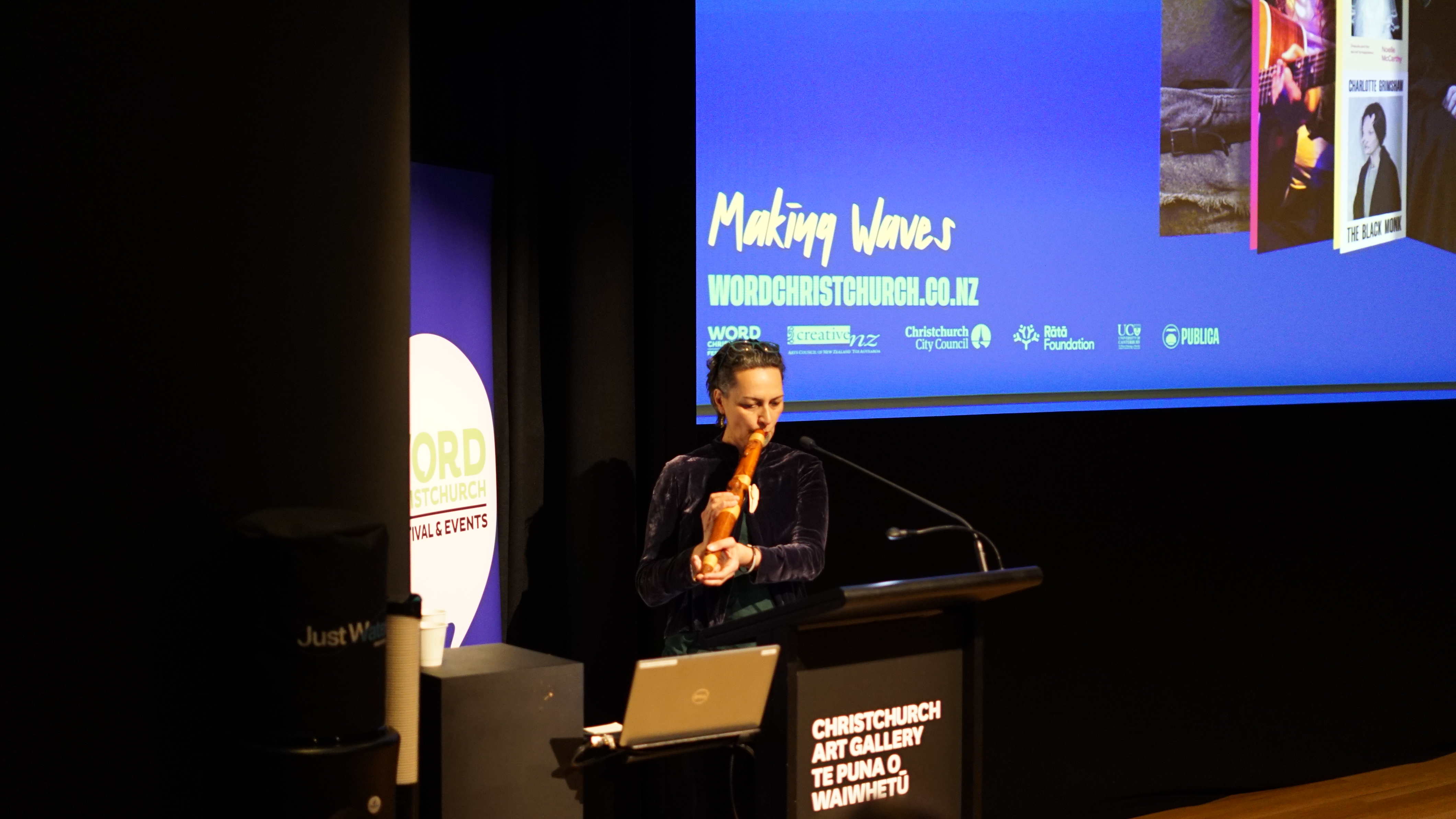
Hot pics from the WORD Christchurch Festival 2026 Programme Launch
Enjoy images from our 2026 programme launch event at Te Puna o Waiwhetū Christchurch Art Gallery.
Learn more
Mānawatia a Matariki! Enjoy this whetū-aligned reading list
We’ve put together a reading list based on each whetū (star) in the Matariki cluster. Jump into timeless favourites, lea
Learn more

Word Social Feed
wordchch
🇳🇿 WORD Christchurch gets the city buzzing with books, ideas and kōrero. Next festival: 1 - 6 September 2026. Watch out for events through the year!